
Michelangelo / Pontormo
I
Michelangelo did not want to paint the Sistine Chapel. Yet Pope Julius II insisted. In 1508 Italy, one could not refuse the pope, so Michelangelo had to paint the Sistine Chapel.
Hoping to get the Chapel over with, Michelangelo sought assistants. Art historian Giorgio Vasari recalls he even brought Aristotile, among five other painters, to Rome in hopes of assisting the frescoes. Aristot i le the painter, not Aristotle the Greek philosopher, unfortunately (no time shenanigans here). Unable to find suitable candidates, Michelangelo painted nearly the whole ceiling himself.
By his own account, painting the Chapel pained Michelangelo immensely. In 1509, he wrote to Giovanni da Pistoia (translated):
I've already grown a goiter from this torture … . My stomach's squashed under my chin, my beard's pointing at heaven, my brain's crushed in a casket, my breast twists like a harpy's. My brush, above me all the time, dribbles paint so my face makes a fine floor for droppings!
My haunches are grinding into my guts, my poor ass strains to work as a counterweight, every gesture I make is blind and aimless. My skin hangs loose below me, my spine's all knotted from folding over itself.
… Because I'm stuck like this, my thoughts are crazy, perfidious tripe … .
My painting is dead. Defend it for me, Giovanni, protect my honor. I am not in the right place—I am not a painter.
First, let's all admire the phrase:
🍑 my poor ass 🍑
from the translation.
…
Ok, good.
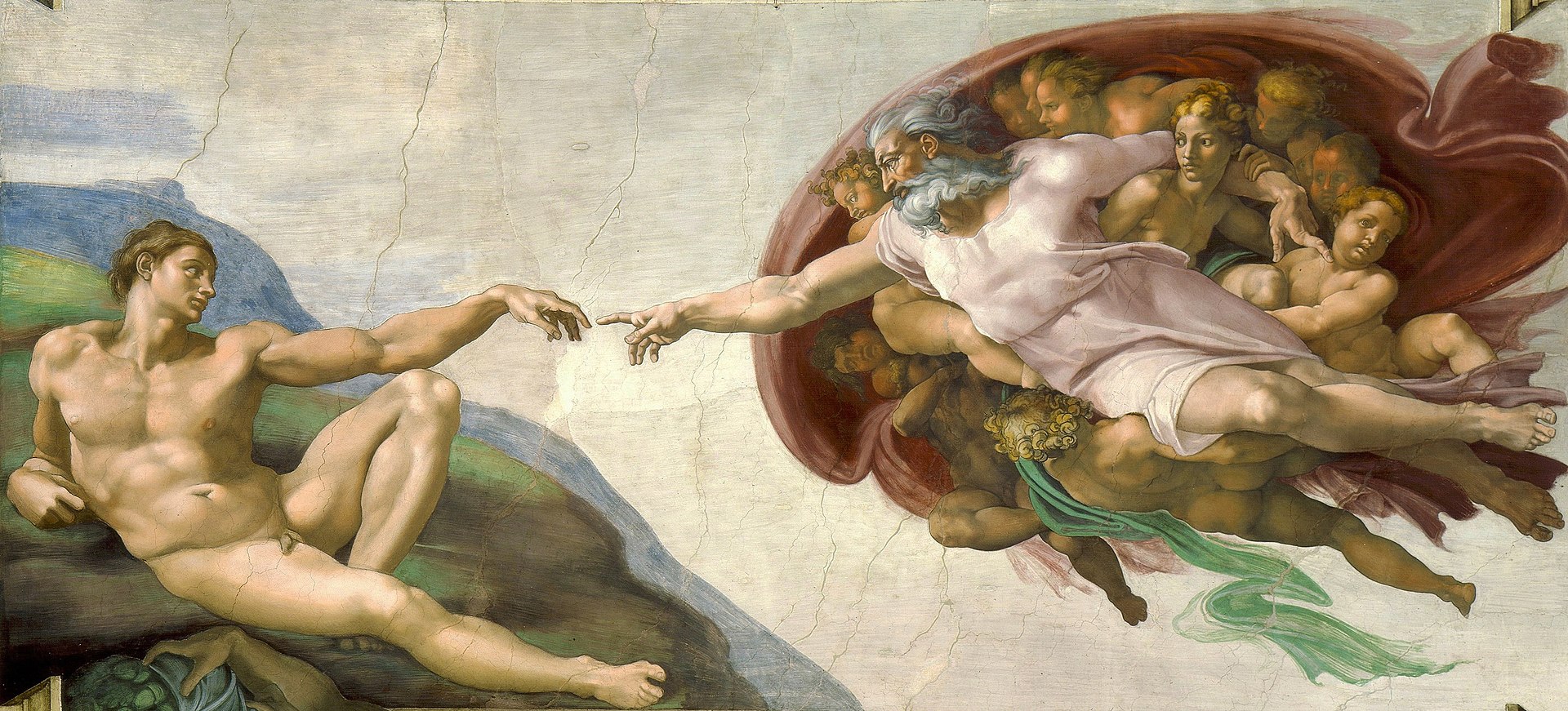
Second, for someone “not a painter,” Michelangelo sure did paint a masterpiece. In fact, when you think “masterpiece painting,” you probably think The Creation of Adam from the Sistine Chapel, if not by name, then by image:
II
Pontormo wanted to paint the Basilica of San Lorenzo. A Mannerist painter taking after Michelangelo, he planned to have the frescoes secure his legacy, become his own Sistine Chapel.
Pontormo sealed off the entire chapel. He built walls and hung blinds so no one could see. Eleven long years with minimal human contact Pontormo spent, and he died before finishing the chapel.

And what of it? Of it, Vasari, the art historian from before, writes (translated):
[I]t does not seem to me that in a single place did he give a thought to any order of composition, or measurement, or time, or variety in the heads, or diversity in the flesh-colours, or, in a word, to any rule, proportion, or law of perspective.
The Basilica of San Lorenzo has none of the magnificent legacy Pontormo hoped.
III
When I work on something very hard, and mostly alone, I sometimes fancy it a very small Sistine Chapel. I wonder, though, how others will react when I reveal it to the world. Will I embody Michelangelo il divino, or Pontormo, dead and delirious?