
Dvorak
Introduction
In my last post, I noted “the QWERTY layout does NOT prioritize the comfort of the human hand." This did not escape the attention of August Dvorak, who in the 1930s created the Dvorak layout:
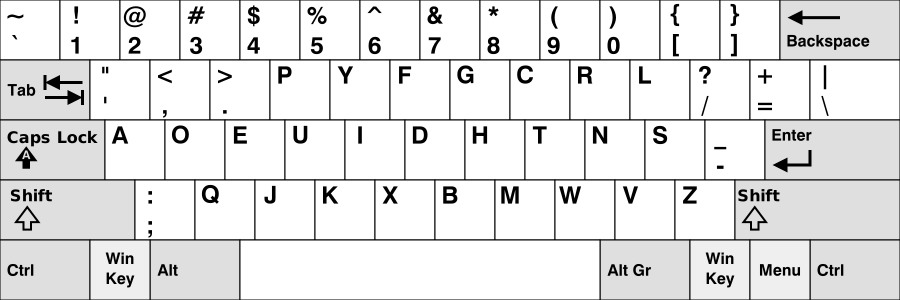
Dvorak designed the layout to overcome the awkwardness perceived of the QWERTY layout, specifically that common letter combinations require too much movement, especially by the left hand and weaker fingers, in the QWERTY layout. Dvorak claimed the new layout would lead to faster typing with less stress on the hands and wrists. Let's investigate.
Typing speed
Dvorak's own 1944 study with the US Navy reported significantly faster typing speeds with the Dvorak layout. However, Liebowitz and Margolis point out flaws in the method, and attribute those results to simply training, rather than the Dvorak layout itself. Subsequent (less biased) studies have shown little to no benefit in typing speed when using Dvorak. Most well-known of these, Earle Strong's 1956 study (with more proper controls) on behalf of the US General Services Administration failed to show any benefit to the Dvorak layout in typing (or training) speed.1
Personally, I don't place much emphasis on pure typing speed. In practice, whether writing prose or code, my thinking bottlenecks, not my fingers.
Repetitive strain
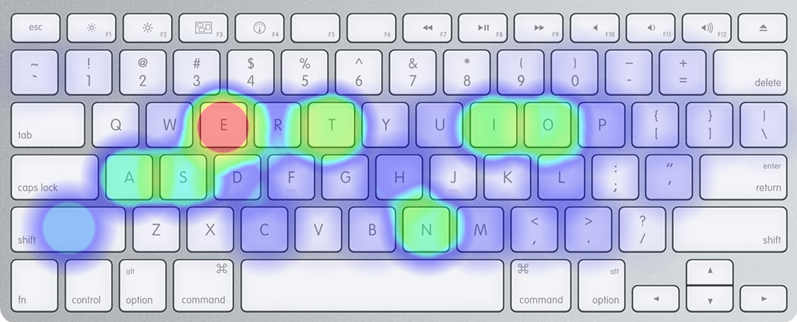
The claim that Dvorak reduces stress on the hands and wrist, though, seems uncontested. By design, Dvorak requires your fingers to move less during common letter sequences, more evenly balances work between the left and right hands, and re-distributes more effort from the weaker to the stronger fingers. We can visualize this with some “heatmaps”:
QWERTY
Dvorak
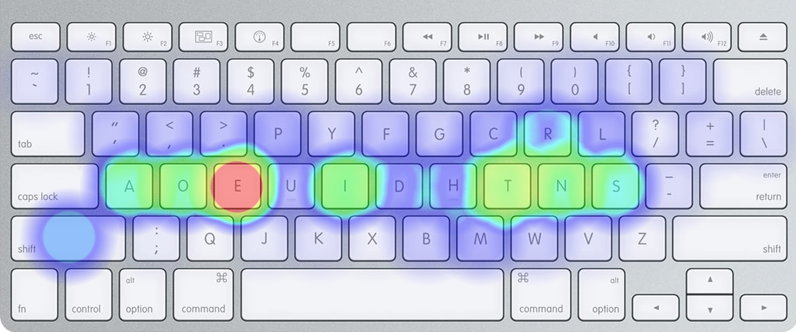
This source also provides some nice heatmaps for various layouts as well.
Reflections I've read from people (e.g. from Bigler and Gao) who've used Dvorak emphasize reduction in typing-related discomfort.
Conclusion
So should you switch to Dvorak? Only if you suffer from or worry about repetitive strain injury enough to justify the extended re-training. Even then, as I've said before, “if you really care about overall ergonomics, perhaps a good chair serves as the best ‘ergonomic keyboard’" That is, you may want to consider your entire computer setup before you adjust your keyboard layout.
Next time, let's talk about the ubiquity of QWERTY.